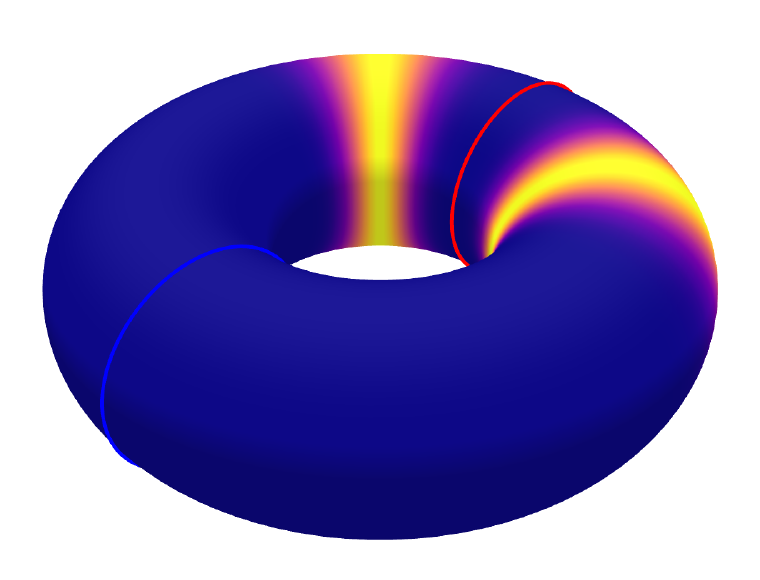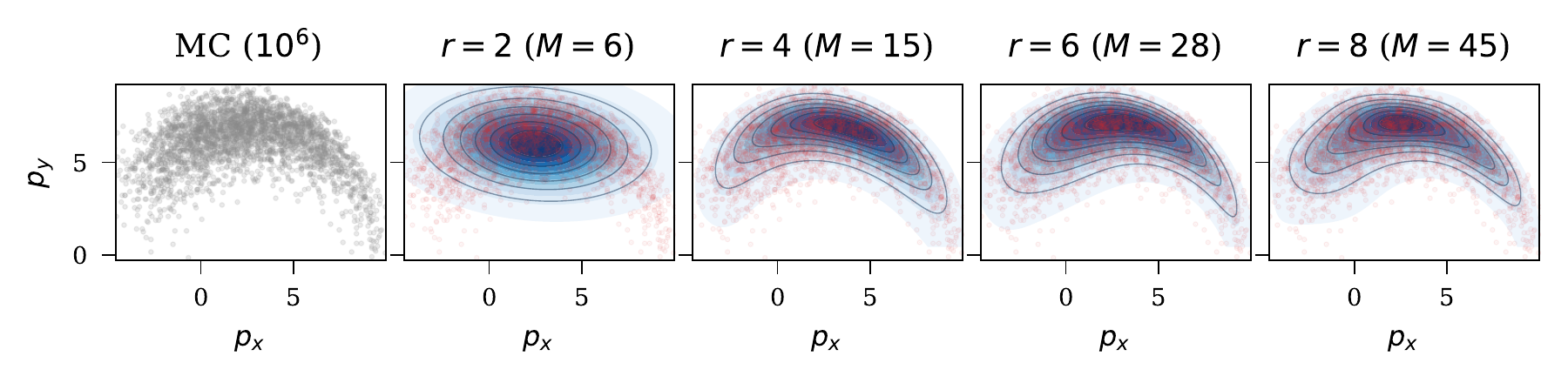
A robot must estimate its state from imperfect measurements. In nonlinear systems, the resulting uncertainty can curve, stretch, or split into multiple likely states. Representing all of these possibilities with a Gaussian distribution can discard information that matters for estimation.
The Score Kalman Filter (SKF) connects score matching, a method used in machine learning, with mathematical identities from probability theory. Developed by Kaito Iwasaki, Anthony Bloch, Taeyoung Lee, and Maani Ghaffari, it reflects FDCL’s focus on rigorous mathematical foundations for AI and autonomous systems.
From probability distributions to linear systems
Moment-based filters summarize uncertainty through quantities such as means, variances, and higher-order moments. Reconstructing a probability distribution from these summaries can require expensive normalization integrals.
SKF avoids those integrals by fitting the score—the gradient of a distribution’s log density—and using Stein’s identity to relate that score to statistical moments. For the representation developed in the paper, density fitting, prediction, and measurement updates are carried out through linear algebra. The classical information-form Kalman filter is recovered as a special case.
What the experiments show
On the paper’s synthetic coupled-oscillator benchmarks, SKF was demonstrated through 20 state dimensions, with lower root-mean-square estimation error than the tested extended, unscented, and ensemble Kalman filters and particle-filter baselines. These results demonstrate the approach on controlled nonlinear examples; evaluation on physical robotic systems remains a further step.
The paper was selected for a NeurIPS 2026 Spotlight presentation. Read the recognition announcement.
Paper
K. Iwasaki, A. Bloch, T. Lee, and M. Ghaffari, The Score Kalman Filter, NeurIPS 2026, accepted, Spotlight.