
The Score Kalman Filter has been selected for a Spotlight presentation at NeurIPS 2026—one of 292 Spotlight papers among 30,709 submissions (approximately 0.95%).
The Conference on Neural Information Processing Systems (NeurIPS) is a flagship international conference in artificial intelligence and machine learning, bringing together researchers advancing the mathematical foundations and applications of AI.
The paper is a collaboration between Kaito Iwasaki, Anthony Bloch, Taeyoung Lee, and Maani Ghaffari, bringing together researchers at the University of Michigan and The George Washington University.
This work reflects FDCL’s focus on connecting rigorous mathematical analysis with AI. By linking probability and estimation theory with score matching, the paper illustrates how mathematical structure can guide new computational methods for robotics and autonomous systems.
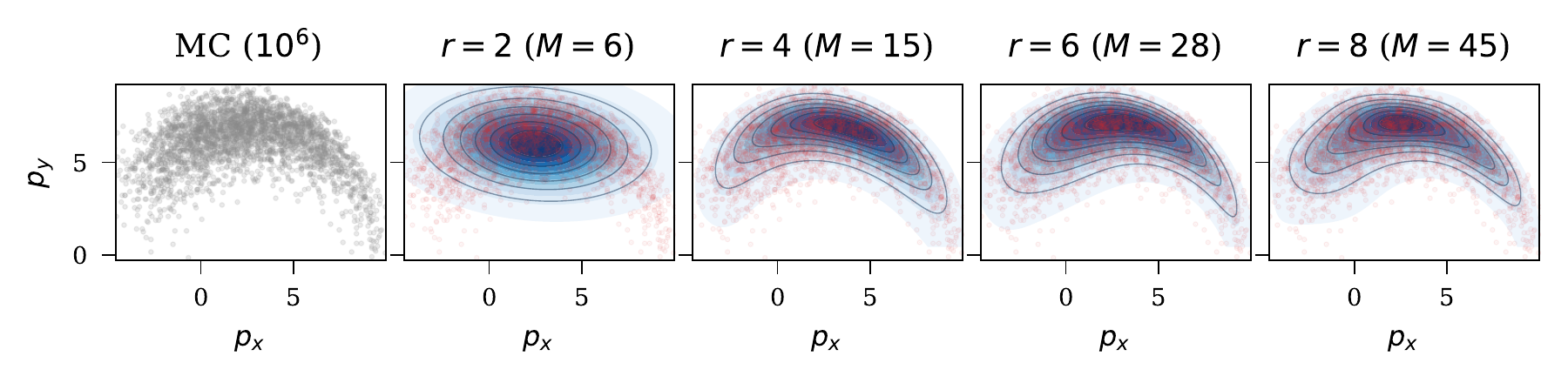
Estimating a system’s state from noisy measurements is central to robotics and control. For nonlinear systems, uncertainty can take curved or multimodal shapes that Gaussian approximations cannot fully represent.
The Score Kalman Filter (SKF) combines score matching with Stein’s identity to represent and update this uncertainty without evaluating costly normalization integrals. Its core computations use linear algebra, and the classical information-form Kalman filter is recovered as a special case.
On the paper’s synthetic coupled-oscillator benchmarks, SKF was demonstrated through 20 state dimensions and achieved lower root-mean-square estimation error than the tested extended, unscented, and ensemble Kalman filters and particle-filter baselines.
Read the paper on arXiv · Download the PDF
Congratulations to Kaito and the entire team on this recognition!