Hybrid systems combine continuous motion with sudden changes. A state may flow along a curved surface until it reaches an event boundary and jumps elsewhere. In more general systems, an event can even change the number of variables needed to describe the state.
FDCL’s research asks how to propagate an entire probability distribution through both continuous motion and discrete resets. The progression is illustrated here in two steps: uncertainty evolving on a torus, followed by merging and splitting particles that change the dimension of the state space.
Uncertainty propagation on a curved state space
Tejaswi K. C., William A. Clark, and Taeyoung Lee develop a transfer-operator framework for stochastic hybrid systems on manifolds. The Koopman operator describes how observables evolve; its dual, the Frobenius–Perron operator, describes how probability distributions evolve.
This leads to a geometric Fokker–Planck equation that combines drift, diffusion, and reset-induced probability transfer. A central requirement is conservation of probability: the probability leaving a guard must reappear at its reset image.
Numerical example: flow, diffusion, and reset on a torus
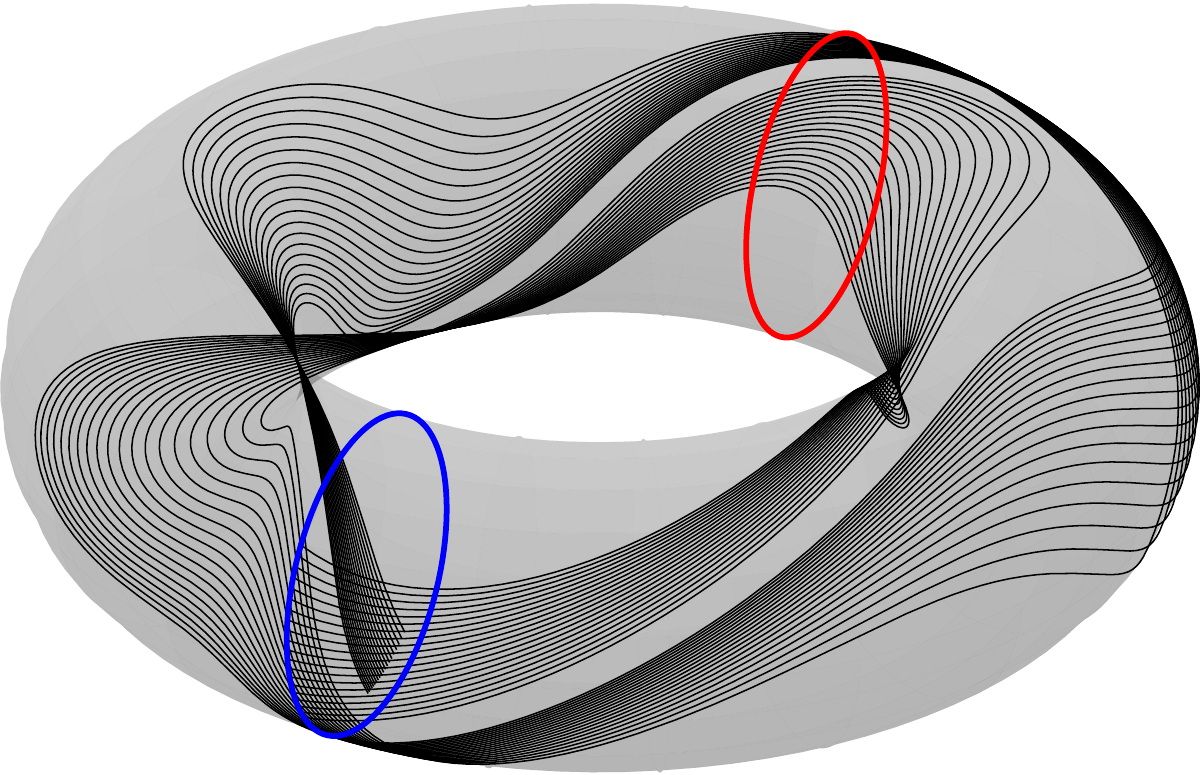
A torus is a two-dimensional curved surface embedded in three-dimensional space. In this example, a deterministic drift carries the state around the surface while Brownian perturbations spread its uncertainty.
When the state reaches the red guard circle, it jumps to the blue reset circle, with a half-turn shift in its phase around the torus’s smaller circular cross-section. The state remains on the same two-dimensional surface, but its location changes abruptly.
The initial distribution forms two bands. As they move, one reaches the guard and resets while diffusion spreads the density. Continued transport, twisting, and resets produce a band connecting the guard and its reset image. The paper checks the finite-volume solution against Monte Carlo simulations and verifies conservation of total probability.
Extending the framework to dimension-varying resets
The torus example preserves the dimension of the state space. Merging and splitting introduce an additional challenge: probability must pass between spaces of different dimensions.
In their CDC 2026 paper, Tejaswi K. C. and Taeyoung Lee describe this transfer using the pushforward of outgoing probability flux through the reset map. This records where probability goes without requiring an invertible map or equal-dimensional state spaces.
When dimension decreases, contributions from multiple source configurations must be combined. When dimension increases, incoming probability can initially occupy only a lower-dimensional subset of the new state space. The formulation accommodates both ordinary densities and concentrated probability sources.
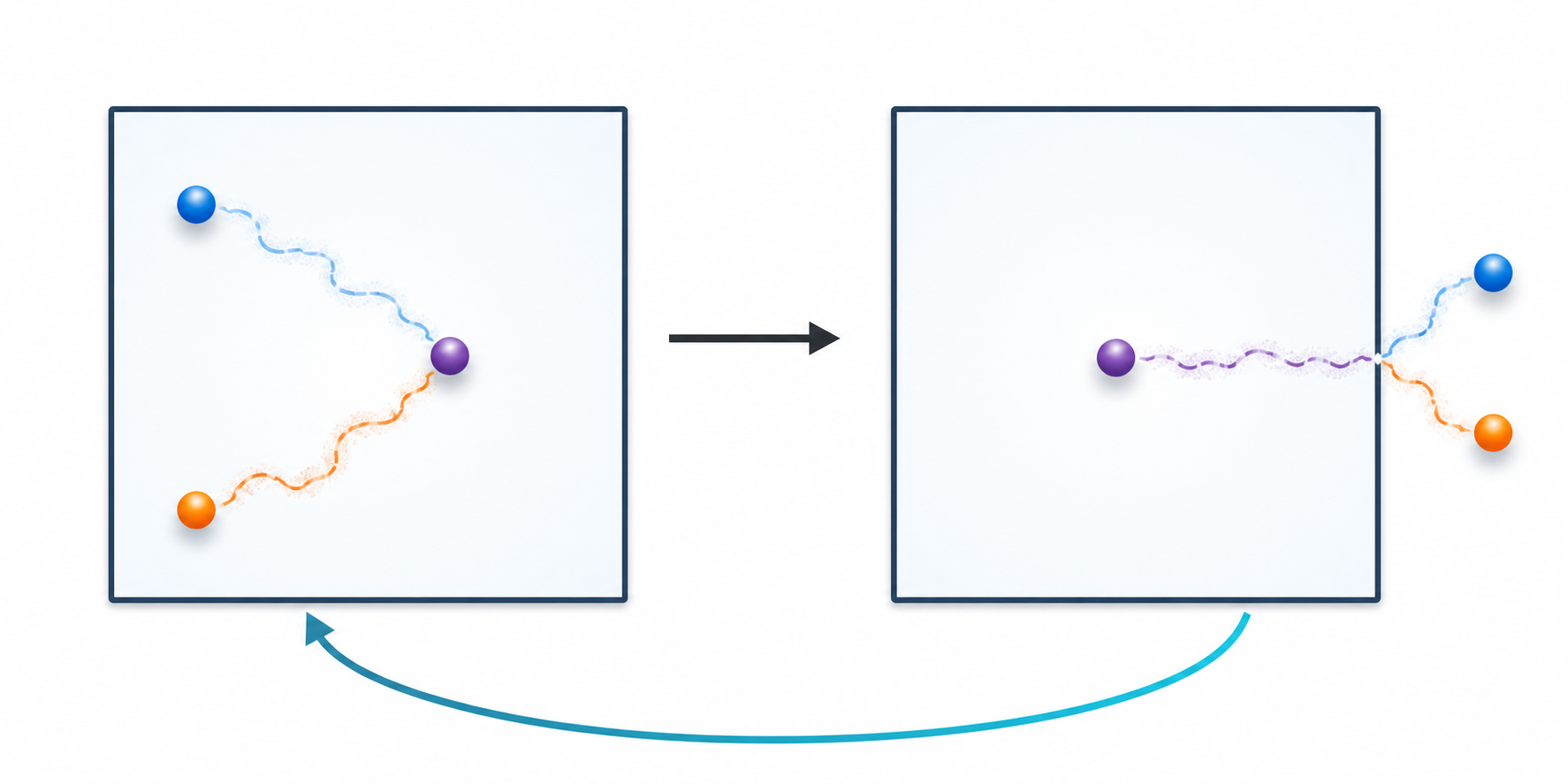
Numerical example: merging and splitting particles
The example considers particles moving in a square under drift and diffusion. In Mode 1, two planar particles require four position coordinates. When they approach within a prescribed distance, they merge at their midpoint. In Mode 2, the merged particle requires only two coordinates. Reaching the right boundary triggers a split into two separated particles inside the square, restarting the cycle.
The simulation therefore transfers probability repeatedly between four-dimensional and two-dimensional state spaces. A finite-volume scheme evolves the distributions while transferring outgoing flux into the receiving mode.
Checking conservation across dimension changes
The mode probabilities oscillate as particles merge, travel to the boundary, and split. Their sum stays at one to the displayed precision, demonstrating conservation of total probability in this numerical example.
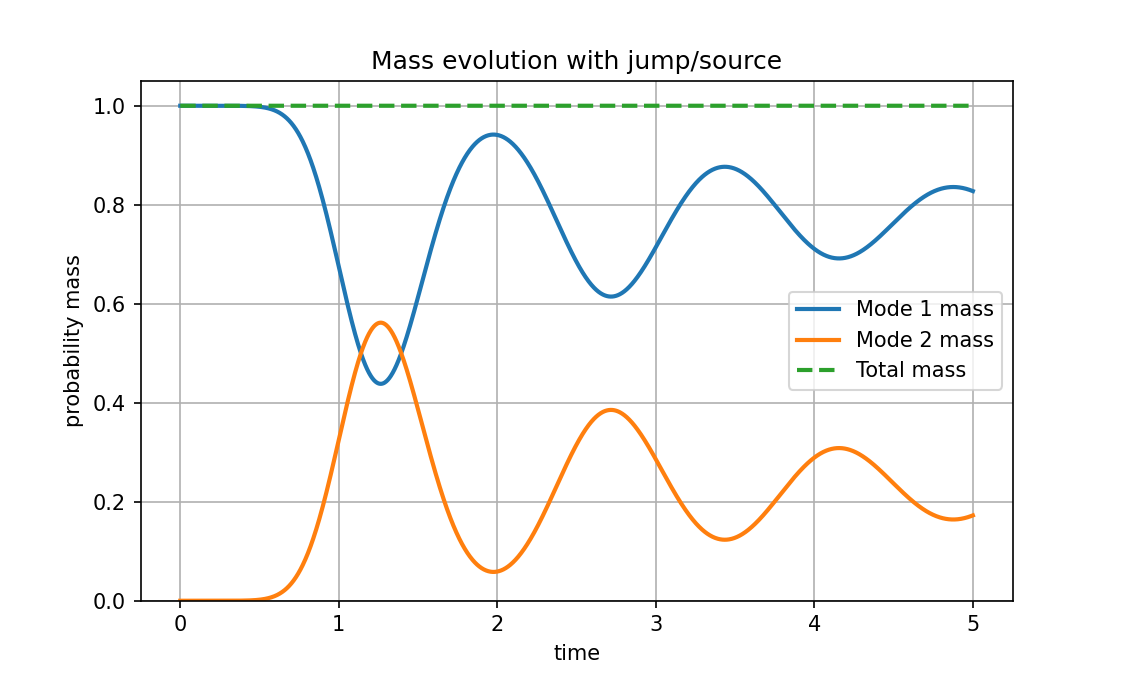
Together, the torus and merging–splitting examples show how geometric analysis connects continuous stochastic motion, discrete resets, and changes in state dimension within a probability-conserving description.
Related publications
-
Tejaswi K. C., William A. Clark, and Taeyoung Lee, Transfer operators for stochastic hybrid systems on manifolds with guard-induced resets, IEEE Transactions on Automatic Control, 2026, submitted. This work develops the manifold-based operator formulation, the torus example, and a numerical scheme that preserves total probability.
-
Tejaswi K. C. and Taeyoung Lee, Uncertainty propagation in stochastic hybrid systems with dimension-varying resets, Proceedings of the IEEE Conference on Decision and Control, 2026, accepted. This paper develops the probability-transfer formulation for dimension-changing resets; the planar merging–splitting simulation above illustrates its extension to four- and two-dimensional state spaces.