A spacecraft turning toward a target and a UAV recovering from a large orientation error face the same underlying problem: how to control a rigid body’s rotation. Small-angle approximations can simplify this task near a desired orientation, but large rotations reveal a deeper issue. The geometry of orientation determines both how a controller should be designed and what stability guarantees it can achieve.
FDCL’s research develops attitude controllers directly on SO(3), the space of three-dimensional rotation matrices. A sequence of publications connects large-angle tracking, topological restrictions, hybrid control, and controllers that retain information about their initial condition. Together, these works show how mathematical structure can guide practical control design.
Why orientation needs its own geometry
Rotations do not form an ordinary vector space. Euler angles have coordinate singularities, while two opposite unit quaternions represent the same physical orientation. A quaternion controller must account for this equivalence to avoid unnecessary rotations known as unwinding.
Working directly with rotation matrices gives each physical orientation a unique representation and avoids local-coordinate singularities. The controller measures attitude error on SO(3), and Lyapunov analysis connects that error to rigorous convergence guarantees. This geometric formulation also provides a foundation for the attitude-control component of quadrotor flight.
Large-angle tracking with exponential convergence
The 2012 study, Exponential Stability of an Attitude Tracking Control System on SO(3) for Large-Angle Rotational Maneuvers, examines how the choice of attitude error function affects performance [1]. Some familiar error measures produce a weak corrective response near an orientation error of 180 degrees, even though the vehicle is far from its target.
The proposed error function improves the response to large initial errors. A strict Lyapunov analysis establishes exponential stability and gives sufficient conditions for trajectories to avoid the error function’s nondifferentiable configurations. The result is a tracking guarantee within a specified domain, rather than an unrestricted global claim.
Topology sets a fundamental limit
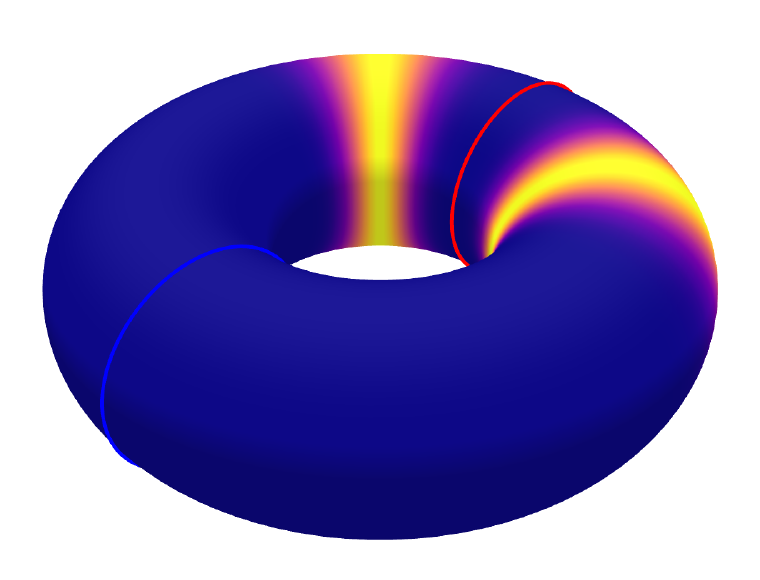
Removing coordinate singularities does not remove the topology of SO(3). Under the usual continuous, memoryless feedback setting, a single desired attitude cannot be made globally asymptotically stable. Smooth geometric controllers can instead achieve almost-global convergence: an exceptional set of initial conditions remains.
This distinction matters in practice. Initial states near undesired equilibria can lead to slow transients, even when eventual convergence is guaranteed. Our work explores two ways to address this restriction by changing the controller structure.
Hybrid control: switching the error landscape
The 2015 paper, Global Exponential Attitude Tracking Controls on SO(3), develops a hybrid controller that switches among direction-based attitude error functions [2]. When one function leaves the system near an undesired equilibrium, another supplies a direction for escape. Hysteresis regulates the switching.
This construction establishes global exponential attitude tracking under the paper’s assumptions. An integral extension addresses unknown constant disturbances. The global guarantee comes from the hybrid controller structure; it does not contradict the restriction on continuous memoryless feedback.
Memory-based control: shifting the reference
The 2017 conference paper and the 2019 journal extension develop a different approach [3, 4]. The controller temporarily shifts the desired attitude trajectory according to the initial condition. This shifted trajectory starts within a suitable tracking domain and converges exponentially to the original reference.
The resulting controller is nonmemoryless: its behavior retains information about initialization. Its dependence on that initial condition can be discontinuous, while the control input remains continuous in time during the maneuver. This distinction allows the method to address the topological restriction without repeated switching of the control torque.
The journal result is global over the orientation space SO(3) and semiglobal over the full attitude-and-angular-velocity state space. It also develops an adaptive extension for unknown constant disturbances.
Connecting the theory to hardware
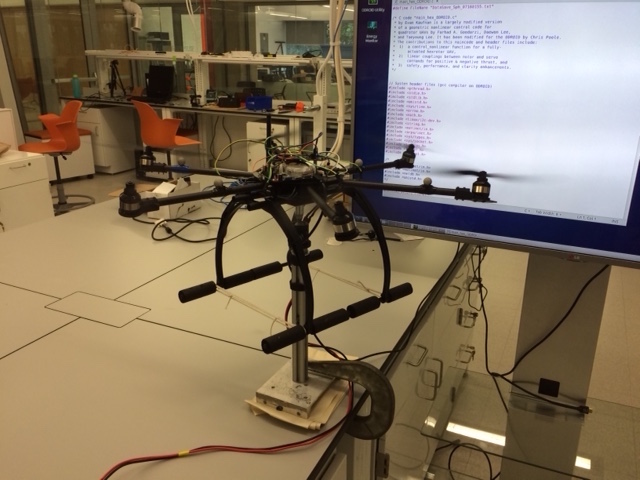
The 2019 study evaluates the adaptive controllers on a hexrotor attached to a spherical joint [4]. Its center of gravity lies above the joint, making the desired upright attitude an unstable equilibrium without control. The experiment begins with an orientation error close to 180 degrees.
Both tested adaptive controllers stabilize the desired attitude. The semiglobal strategy avoids the slow initial response observed with the almost-global strategy in this experiment. This is a constrained attitude-control test, not a free-flight demonstration, and it provides hardware evidence for the importance of controller design near large initial errors.
These results connect a fundamental question—what topology permits—with concrete choices about tracking performance, disturbance rejection, and control-input continuity. They form part of the mathematical foundation for FDCL’s broader work on geometric flight control and aerial transportation.
References
- T. Lee, “Exponential stability of an attitude tracking control system on SO(3) for large-angle rotational maneuvers,” Systems & Control Letters, 61(1), pp. 231–237, 2012. Paper.
- T. Lee, “Global exponential attitude tracking controls on SO(3),” IEEE Transactions on Automatic Control, 60(10), pp. 2837–2842, 2015. Paper · Preprint.
- T. Lee, D. E. Chang, and Y. Eun, “Attitude control strategies overcoming the topological obstruction on SO(3),” Proceedings of the American Control Conference, 2017. Paper.
- T. Lee, D. E. Chang, and Y. Eun, “Semiglobal nonmemoryless attitude controls on the special orthogonal group,” ASME Journal of Dynamic Systems, Measurement, and Control, 141(2), article 021005, 2019. Paper · Preprint.