A UAV’s orientation is a rotation, a pointing direction lies on a sphere, and a constrained mechanism moves on a curved configuration space. In each case, uncertainty must respect the geometry of the possible states. Simply adding independent noise to every coordinate can move a state off its constraint or produce the wrong diffusion.
In Geometric Interpretation of Brownian Motion on Riemannian Manifolds, Taeyoung Lee and Gregory S. Chirikjian explain how to construct random motion consistently across these spaces. The work brings intrinsic geometry, embedded surfaces, and Lie groups into one framework, making the geometric meaning of stochastic equations explicit.
Why random motion needs a geometric correction
In ordinary Euclidean space, Brownian motion is built from independent Gaussian increments. On a curved space, the directions in which motion is allowed change from point to point. Noise applied along those directions can therefore require a systematic correction—a geometric drift—to produce the intended diffusion.
The paper starts from a common defining principle: Brownian motion has a generator equal to one-half of the Laplace–Beltrami operator, the curved-space counterpart of the Laplacian. This connects random sample paths to heat diffusion on the manifold. Noise is introduced along an orthonormal frame, and the drift is derived to satisfy that generator condition.
One principle, three geometric viewpoints
The framework explains the corrections in three complementary ways:
- Intrinsic manifolds: covariant derivatives describe how the local frame changes along the surface.
- Embedded manifolds: the mean curvature vector explains the drift in the ambient Itô equation.
- Lie groups: the group structure gives an algebraic expression for the intrinsic drift. This term vanishes for unimodular groups, including SO(3), although an ambient Itô equation can still contain a curvature correction.
Both Itô and Stratonovich formulations are developed. The contribution is a unified derivation and interpretation of Brownian motion, with explicit connections between these descriptions.
Sample paths across different spaces
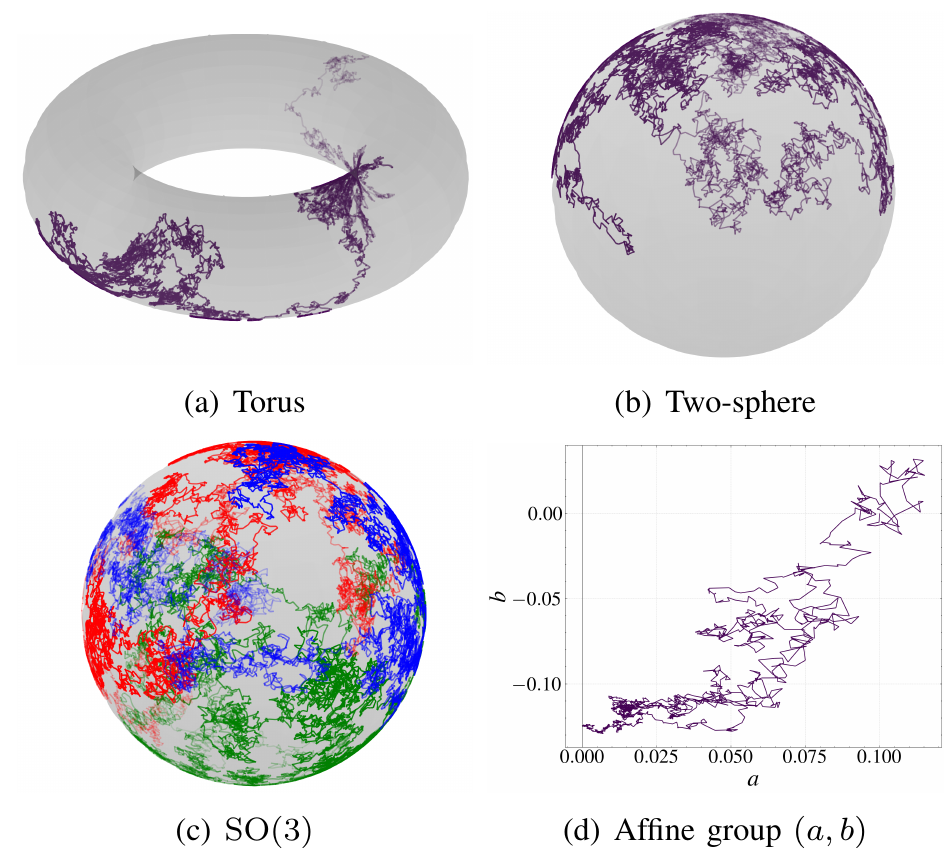
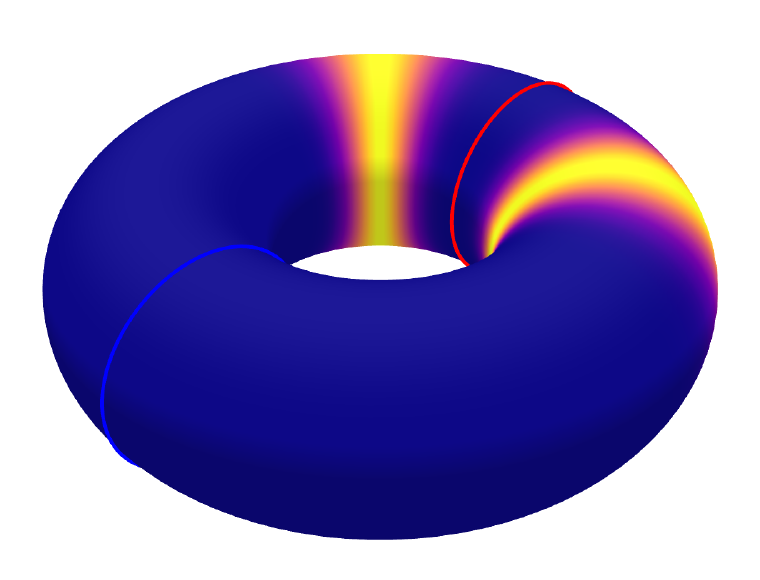
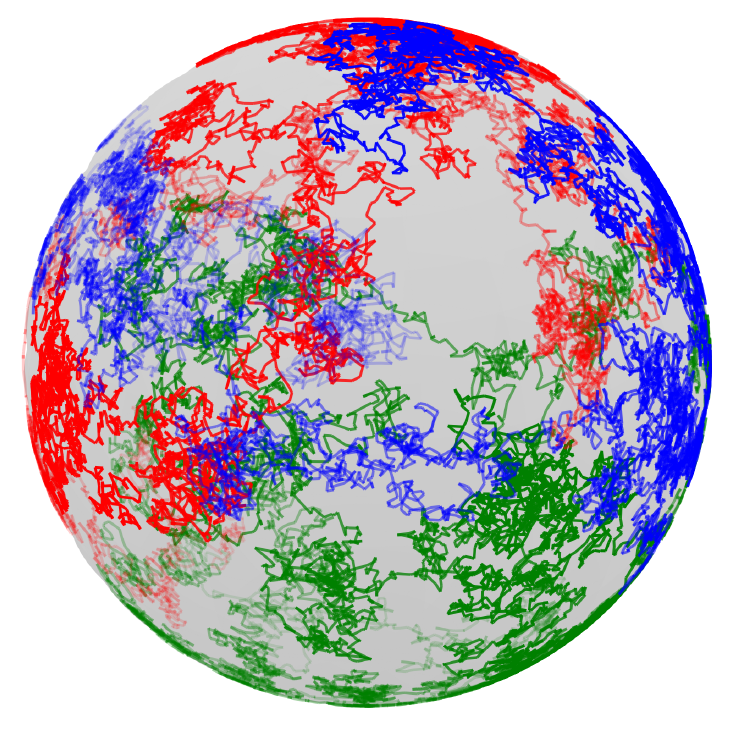
The torus illustrates the role of the metric: the usual surface metric and a left-invariant group metric lead to different Brownian motions on the same underlying space. The sphere makes curvature-induced drift concrete, while SO(3) connects the theory directly to attitude uncertainty. The affine group, describing positive scaling and translation, provides a non-unimodular example in which the intrinsic group drift is nonzero.
An additional numerical check for rotations
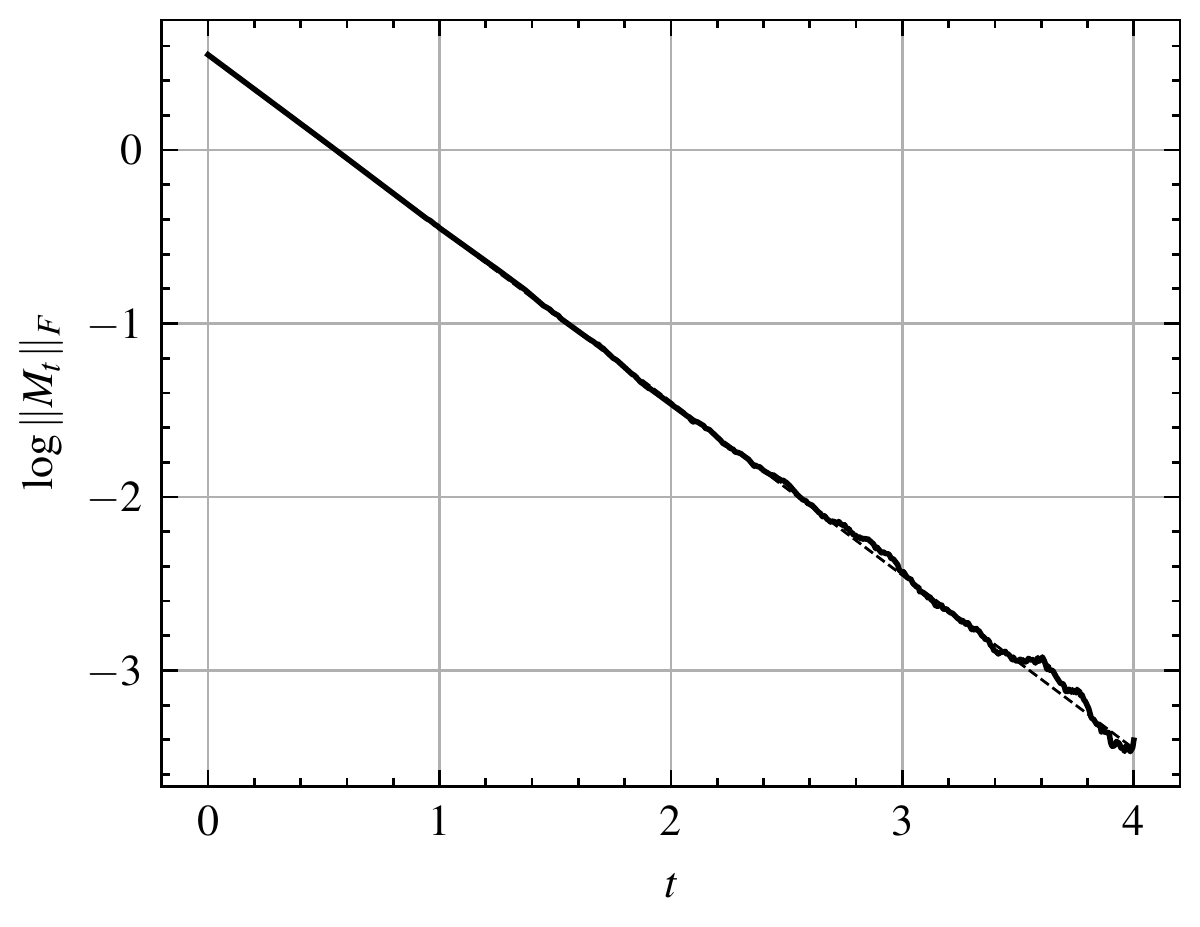
Beyond the manuscript’s sample-path figures, the accompanying simulation materials include a Monte Carlo check of the mean rotation matrix. For the normalization used in the SO(3) example, the theory predicts E[R(t)] = e−tR(0).
Starting from the identity, the logarithm of the Frobenius norm of this mean should decrease along a straight line with slope −1. The numerical result follows that prediction closely, with finite-sample deviations becoming more visible at later times. This is an average of rotation matrices in the ambient matrix space; the average need not itself be a rotation.
Foundations for control, estimation, and AI
Geometrically consistent noise models support stochastic control, attitude estimation, and diffusion-based generative models on manifolds. This work clarifies the mathematical foundations these methods rely on: how to define diffusion that respects a state space’s metric, curvature, and symmetry.
It complements FDCL’s research on uncertainty propagation in hybrid systems, where continuous stochastic motion is combined with discrete resets and changes in state dimension.
Paper
Taeyoung Lee and Gregory S. Chirikjian, Geometric Interpretation of Brownian Motion on Riemannian Manifolds, IEEE Transactions on Automatic Control, submitted. The arXiv preprint was posted in October 2025.